
The Construction Labour Shortage: Why Builders Are Building Their Own Workforce
41% of the construction workforce retires by 2031. Here's how builders are training their own.
Key takeaways
- The construction labor shortage is about to get worse. NCCER estimates 41% of the current construction workforce will retire by 2031.
- Waiting for the market to fix it means competing for a shrinking pool of experienced workers and bidding up wages.
- Young people are more open to the trades than the old narrative suggests. What's been missing is a clear on-ramp.
- Builders ahead of this do three things: build a real apprenticeship path, partner with local CTE programs, and market careers instead of posting jobs.
- A builder who trains their own workforce gets people shaped by their standards, and that advantage compounds every year.
Stop treating the construction labor shortage like the weather
For years, the construction industry has treated its labor shortage like weather. Something that happens to you. You post a job, you wait, and if nobody shows up, you blame the market.
That doesn't work anymore. Not with what's coming.
How big is the construction labor shortage?
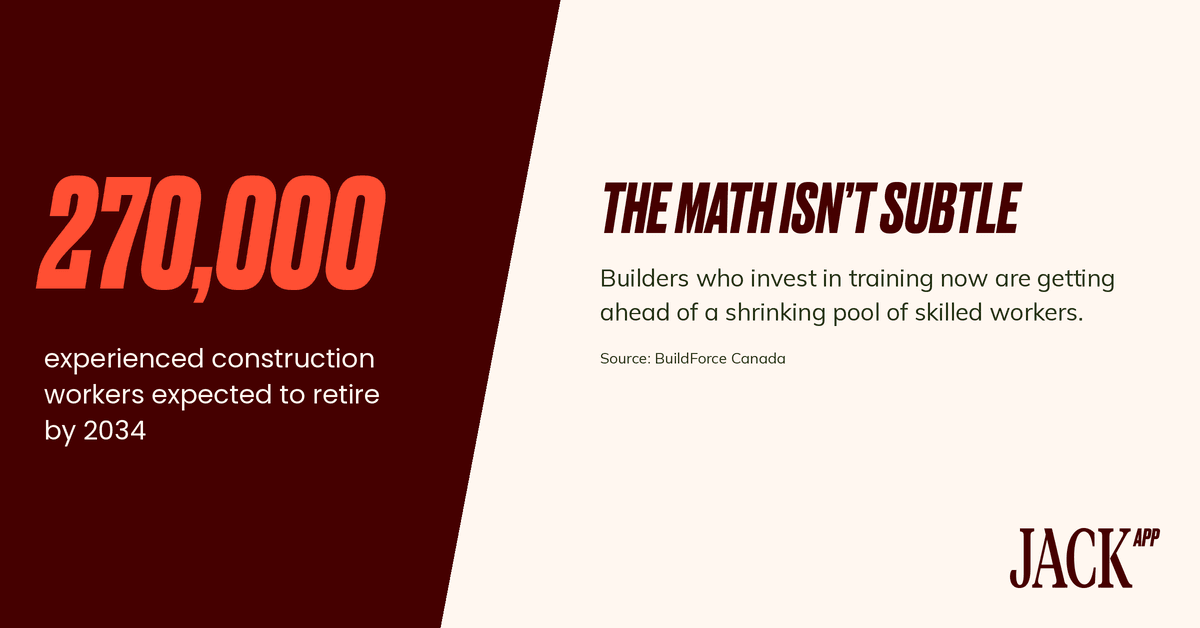
The math is not subtle. The National Center for Construction Education and Research (NCCER) estimates that 41% of the current construction workforce will retire by 2031. That is not a distant problem. That is five years away.
And the workers we do have aren't getting any younger. Every builder reading this already feels it. Your best site supervisor is 58. Your most experienced estimator has been doing this since before you started your company. When they leave, they don't just take a seat on the org chart with them. They take twenty years of judgement calls that never made it into a manual.
The builders who wait for the market to solve this are going to spend the next few years competing for a shrinking pool of experienced workers, bidding up wages, and losing projects to labour gaps. The builders who start building their own pipeline now are going to spend those same years training people who are loyal to them, shaped by their standards, and ready to step up exactly when the veterans step out.
Are young people interested in the trades?
There's a narrative that young people don't want to work with their hands. That isn't true anymore, if it ever was. Gen Z is more open to the trades than the industry gives them credit for.
What's changed is the on-ramp. A few years ago, if a young person wanted to get into a trade, the path was murky. Find an employer willing to take a chance on you, figure out training on your own, hope it works out.
That's starting to change. Governments and major employers in different parts of the world are putting real money and structure behind getting people into the trades, whether that's incentive payments for apprentices, free TAFE places, or employer-led programs that line up a job before someone even finishes. The mechanisms differ, but the signal is the same: the trades are being treated as infrastructure worth investing in, not an afterthought.
That shift matters for builders too. When national programs make the trades visible and credible as a career path, it gets easier for every builder to recruit into that same pipeline, whether it's a formal program or a partnership you build yourself.
How builders can build their own construction workforce
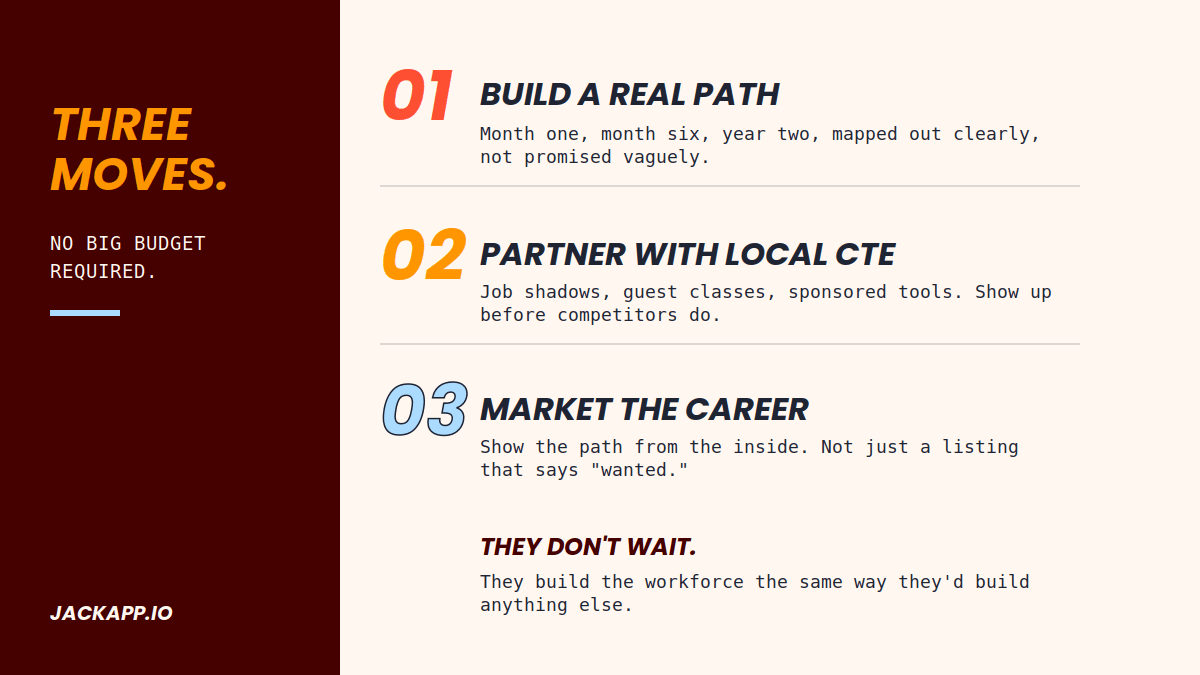
A national program doesn't let a builder off the hook. Incentive payments and free TAFE places get someone into the industry, but they don't get someone into your company. The builders who are ahead of the construction labour shortage are doing three things on top of whatever's happening at the national level, and none of them require a huge budget to start.
1. Build a real construction apprenticeship path
Not a vague promise to "train someone up." An actual construction training program: what a new hire learns in month one, month six, year two, and what they're qualified to do at each stage. When the path is clear, people can see themselves in it.
A real path also needs your standards written down somewhere a new hire can find them. If your schedules, checklists and job notes live in a veteran's head, they leave when the veteran does. Keeping them in one place in construction management software means a new crew member learns how your company actually builds.
2. Partner with local schools and TAFE
VET in Schools programs and local TAFE campuses are sitting on exactly the talent builders say they can't find. Showing up at these programs, offering work experience placements, guest-teaching a class, or sponsoring tools and equipment puts your company in front of people before your competitors even know they exist.
3. Market careers, not just job ads
Hiring construction workers off a job board is hard when your ad looks like everyone else's. An ad that says "carpenter wanted" competes with every other ad that says the same thing. A video of an apprentice explaining what their first year looked like, or a post about a crew member who started as a labourer and now runs jobs, does something a job board can't. It shows someone what the path looks like from the inside.
None of these are complicated. What they have in common is that they don't wait. They treat the workforce as something a builder builds, the same way you'd build a client pipeline or a network of subbies.
Why building your own workforce becomes a real advantage
Here's the part that gets missed. This isn't just about filling seats. A builder with their own training pipeline has something a competitor chasing the open market doesn't: people who were trained on that company's standards from day one, who know the systems, and who feel invested in because the company invested in them first.
That's not a hiring win. That's a competitive advantage that compounds. Every year you run your own pipeline, you widen the gap between yourself and the builders still hoping the right CV lands in their inbox.
"The retirement wave is coming either way. The only question is whether you're ready for it."
The bottom line
The construction labour shortage isn't going away. But not every builder is going to feel it the same way. The ones who keep waiting are going to get hit hard. The ones who started building their own workforce years ago are barely going to notice.
Want your standards to outlast your veterans? Book a demo and we'll show you how JACK App keeps your jobs, schedules and processes in one place.
Frequently asked questions
Why is there a construction labour shortage in Australia?
Demand for new housing is outpacing the workforce. BuildSkills Australia estimates residential construction needs 116,700 extra workers to reach the Housing Accord target of 1.2 million new homes by mid 2029, while experienced tradespeople are retiring faster than new ones are coming through.
How can builders deal with the construction labour shortage?
By building their own pipeline instead of waiting for the open market. That means a clear apprenticeship path with stages and skills, partnerships with local schools and TAFE, and marketing the career, not just posting the job.
How do you start a construction training program?
Map out what a new hire learns and is qualified to do at month one, month six and year two. Write down your standards and processes so they can be taught, then pair each new hire with an experienced crew member.
What's the best way to find and hire construction workers?
Get in front of people before they start job hunting. Work experience placements, guest-teaching at schools and TAFE, and sponsoring tools build relationships early, and content showing real career paths at your company stands out more than a standard job ad.
Subscribe to Newsletter
Dan Morton is the founder of JACK App.
Dan is a residential builder who runs his own building company, Adelaide Green Homes, alongside JACK App. He built JACK App to manage his own jobs, schedules and numbers, and his team still uses it every day.