
How Builders Can Adapt to a Slower Market (and Keep Construction Overhead in Check)
Five ways builders can adapt to a slower market, from your build process to your overhead.
Key takeaways
- Adjust your build process so it can handle new job types, like renovations.
- Widen your trade base before you need new trades or suppliers.
- Respond to leads first. In a tighter market, the fastest follow-up usually wins the job.
- Point your marketing at the work you want next, not just what you've built before.
- Size your construction overhead to the work you actually have, not the work you hope for.
The work is still there. It just looks different.
There's still plenty of work for residential builders. It just isn't the same work it was a couple of years ago. Interest rates are rising, the property market is adjusting, and clients have less borrowing power. That changes what people build, who's buying, and how much work lands in your pipeline.
The builders who keep winning jobs will be the ones who change with that demand. The ones running the same playbook, carrying the same construction overhead and waiting for the old work to come back, are going to feel it.
I run my own home builder business as well as JACK App, so I'm living this too. Step one is staying on top of the market and what your clients are actually doing. Step two is being willing to change because of it. Here are five places where I see builders either meeting that new demand or missing it, from how you build to how you size your costs.
1. Adjust your build process for the work that's out there
Here's a real example. You might have been a new home builder for years. But with fewer new homes going up, a lot of homeowners are holding on to what they've got and renovating instead. The search data backs this up: according to Google Keyword Planner, searches for "bathroom remodel near me" across the US and Canada were up 50% year over year, and "kitchen remodel near me" was up 23%. For plenty of builders, that means getting back into renovations.
The problem is most builders have a process tuned for one kind of job. It works great until the job changes. Then the schedule doesn't fit, the steps are in the wrong order, and things get missed.
Adaptable builders treat their construction process as something they can adjust, not something set in stone. Write down how you build today. Then ask what would need to change if your next ten jobs looked different. If you can't answer that, the work is going to go to someone who can.
Questions to ask before you take on a new job type
- Which stages of my current schedule don't apply, and which new ones are missing?
- Where will surprises show up, and how much buffer do I need for them?
- Who on my team owns the checklist for this type of job?
2. Build a trade base that can follow the work
A new kind of job usually means new people. The framer who's great on new builds might not be the right fit for a renovation, where every job throws up surprises. Your go-to supplier might not carry what a different build needs, or might not price it well.
Loyalty to good trades matters. I'm not saying throw it away. But if your whole trade base only knows one way of building, it limits what you can take on.
Start widening the bench before you need it:
- Have a few conversations with new subcontractors now.
- Get pricing from a new supplier.
- Try a new trade on a smaller job first.
When the right opportunity shows up, you want to be able to say yes without scrambling.
3. Respond to construction leads faster than your competitors
The leads are still coming in. But with clients borrowing less, more builders are chasing each one. That means rethinking your sales tactics, starting with speed.
When work was plentiful, you could get back to someone in a few days and still win the job. Those days are gone. The builder who responds first and follows up properly is usually the one who gets the conversation.
"A lead that sits in an inbox over the weekend is a lead you've probably handed to someone else."
Being reactive here is a good thing. A simple lead follow-up process for builders looks like this:
- Know every place your leads come in (website, phone, social, referrals).
- Make one person responsible for calling them back.
- Follow up more than once.
It sounds basic. But plenty of builders lose work not because of price or quality, but because they were slow.
4. Point your builder marketing at the work you want next
The work is out there, but the people looking for it won't find you if your marketing only shows what you used to build. A website and social feed full of one type of home tells people that's all you do.
Think about who the new client is. What do they care about? Where do they look for a builder? With less borrowing power, some clients will hold off on building new and look at renovating instead. A family upgrading the home they already own wants different things from a first-home buyer, and they won't respond to the same message.
You don't need to start from scratch. Show the work that matches where you're heading. Talk to the client you want, not just the one you've always had.
5. Size your construction overhead for the work you actually have
This is the one that quietly sinks builders. It's easy to staff up and spend for the business you hope to have. It's a lot harder to carry those costs when the work doesn't show up. With clients borrowing less, your pipeline can thin out faster than you'd expect.
Your construction overhead should match the work you actually have coming, not the work you had last year or the work you're hoping for. That's everything you pay to keep the business running whether a job is on or not: office staff, rent, vehicles, insurance, software, and your own salary.
How to check if your overhead fits your pipeline
- List your fixed costs. Add up what you spend each month regardless of how many jobs you're running.
- Look at confirmed work only. Count the jobs that are signed or close to it for the next few months, not the ones you're hoping to win.
- Compare the two honestly. If the margin from confirmed work doesn't cover your overhead, something has to give before the gap shows up in your bank account.
- Decide what can flex. Some costs can be paused, shared, or shifted to per-job instead of fixed. Work those out now, while you still have options.
Being lean doesn't mean being small forever. It means you grow when the work is there, not before. The builders who stay flexible on overhead are the ones still standing when the market turns, and still in a position to take on the right work.
Adapting is a habit, not a one-off
None of these are things you fix once and forget. The work will keep shifting over the next few years, and keeping momentum will take real thought and real strategy. That means checking your process, your trades, your leads, your marketing, and your costs again and again.
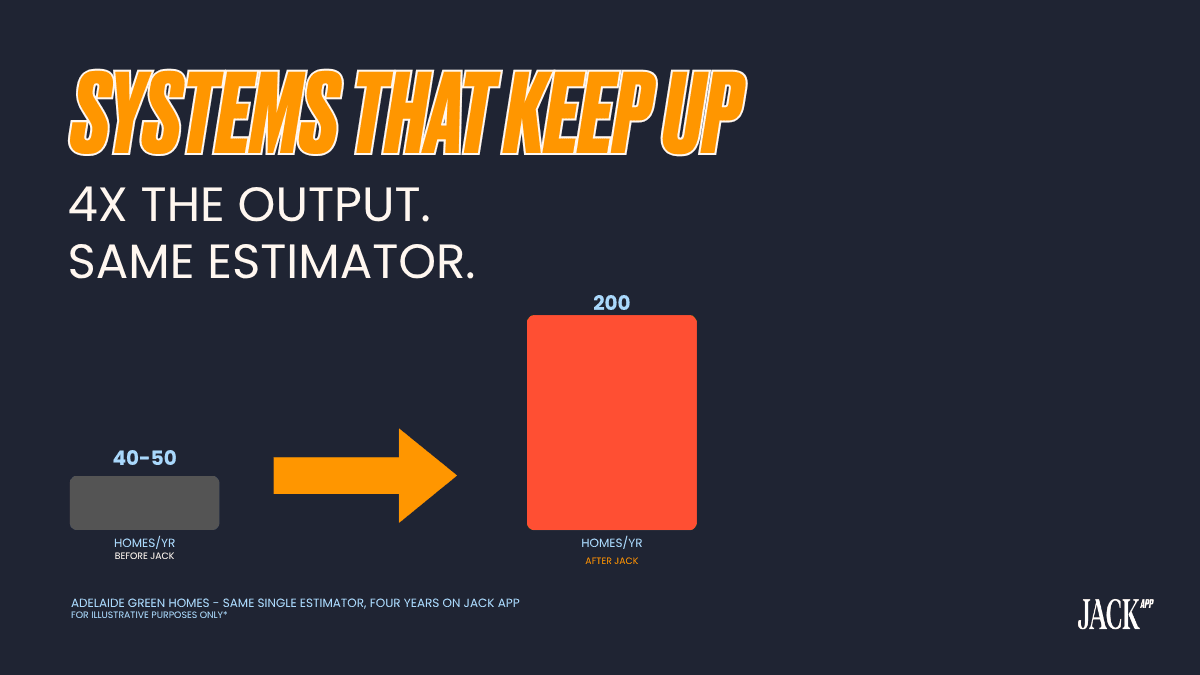
It's a big part of why we built JACK App the way we did. We build it, we use it. In my own building business, having our jobs, schedules, and numbers in one place helped one estimator support a jump from around 40 to 50 homes a year to about 200. That's what adapting looks like when your construction management software can keep up with you.
Like always, the best builders will win. Everyone will come out of this. The work is still there, and it's going to the builders willing to meet it.
So which of these five are you working on right now, and which one have you been putting off?
Ready to see how JACK App helps builders adapt? Book a demo and we'll show you how to keep your jobs, schedules, leads and numbers in one place.
Frequently asked questions
How can a home builder business adapt to rising interest rates?
Start by tracking what your clients are actually doing, then change with that demand. That usually means adjusting your build process, widening your trade base, following up on leads faster, updating your marketing, and keeping overheads in line with your real pipeline.
Should new home builders move into renovations?
For many builders, yes. With fewer new homes going up, more homeowners are renovating what they already own. Before you switch, map your current process and work out what has to change for renovation jobs, where surprises are common.
How fast should builders follow up on new leads?
As fast as you can. In a tighter market the first builder to respond usually gets the conversation, so a lead left in an inbox over the weekend is often a lost job. Assign one person to own follow-up and contact each lead more than once.
What is construction overhead?
Construction overhead is the cost of running your building business that isn't tied to a single job, such as office staff, rent, vehicles, insurance, and software. Unlike job costs, overhead keeps coming whether you have one home on the go or twenty.
How do builders reduce construction overhead in a slow market?
Match your team, office, and fixed costs to the work you actually have confirmed, not last year's volume or the work you hope to win. Identify which costs can be paused or shifted to per-job, and grow again when the work is there, not before.
Subscribe to Newsletter
Dan Morton is the founder of JACK App.
Dan is a residential builder who runs his own building company, Adelaide Green Homes, alongside JACK App. He built JACK App to manage his own jobs, schedules and numbers, and his team still uses it every day.